





The Holy week in Barcelona
The Holy week in Spain can be very impressive, depending on the Autonomous Region, you can see unbelievable processions. The week is dedicated to celebrate the salvation of the God, through his son Jesus and the beginning of the new alliance between God and man. During 1 week, representations of the Christ, Virgin and/or Cross are getting out from the church by different brotherhoods. A lot of people want to bear those representations, in spite that they can be extremely heavy, because it is an honour and selected people are very proud to have the privilege to do it. |
|
It commemorates the passion, the death and the resurrection of Jesus which, through the steps of the procession, show his last moments and his resurrection. Following the procession days:
 |
 |
- the palm sunday (the sunday before the holy thursday) commemorates the entry of Jesus in Jerusalem in which people welcomed him with branches of olive trees because symbol of life
- the holy monday, tuesday and wednesdays, have some processions but of minor importance
- the holy thursday commemorates the last dinner, in which Jesus was sold and betrayed by Judas
- the good friday commemorates the passion (the calvary) and the death of Jesus after to bear the cross in the streets and to be crucified at the end
- the holy saturday commemorates the rest of Jesus in the sepulchre and during night time, the Easter Wake is celebrated and it commemorates his resurrection
- the sunday of easter or resurrection of the Lord
- the easter monday commemorates the resurrection of the Lord.
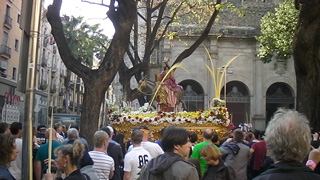
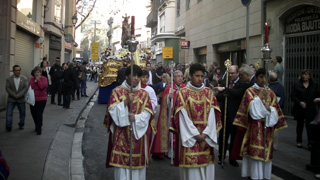
In Barcelona, like every year, you can see the procession of the palm sunday with the step of Jesus entering Jerusalem in triumph on a donkey. It starts at 10h at the church of Sant Agusti (plaza san agustín 2) and it crosses hospital, la rambla, santa anna, portal de l'àgel, cucurulla, portaferrisa, la rambla and hospital street before to be back again at the church around 12h.
 |
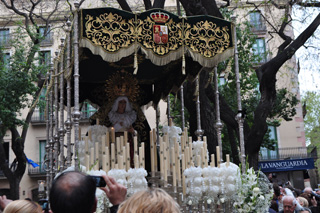 |
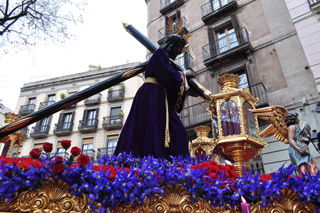
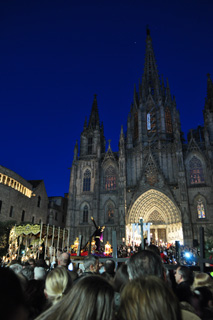
On the good friday, there are 2 processions. One starts at the same church at 17h with the steps of the most blessed Virgin of Hope Macarena and our Father Jesus the Great Power. It crosses hospital, la rambla, santa anna, portal de l'àngel, arcs, plaza nova, avinguda cathedral (around 20h to unite with the 2nd procession), boters, pi, plaza del pi, cardenal casañas, plaza de la boqueria and hospital street before to be back at the church around 22h30.
The other starts at the church of Sant Jaume (calle ferran 28) at 18h45 with the step of our Lady of Sorrow. It crosses ferrán, plaza san jaime, bisbe, avinguda de la catedral (around 20h to unite with the 1st procession), boters, pi, plaza del pi, cardenal casañas, plaza de la boquería, ramblas and ferrán street before to be back at the church around 23h.
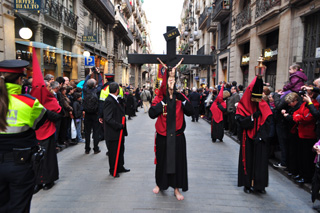
On the other hand, if you want to assist to a lay procession, you have to go to Hospitalet del Llobregat (at plaza catalunya, take the train direction molins del rei and get off at hospitalet de llobregat station). According to the founder of the brotherhood 15+1, this procession has been born in order to recreate the holy week of Seville because it has been formed by 15 andalusians in 1977 to keep their tradition in Catalonia.
 |
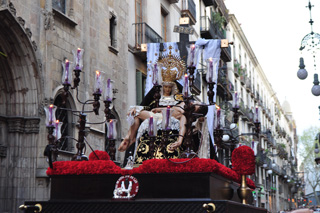 |
Why lay ? Because representations aren’t owned by any church and processions start and end in the headquarter of the brotherhood (located at plaza de la bóvila) instead of a church.
The palm sunday starts at 11h with the “borriquita” procession and at 18h30, the “captive Jesus” procession. The good friday is the “Jesus the nazarene and our lady of the pain” procession at 8h30 and “Christ of the expiation” procession at 21h. The holy saturday is the “holy sepulchre and our lady of the loneliness” at 20h. The holy sunday is the “Jesus resuscitated and our lady of the remedies” procession at 18h.
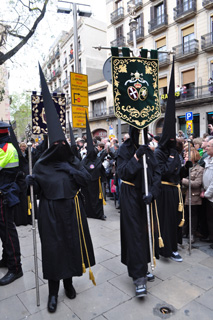
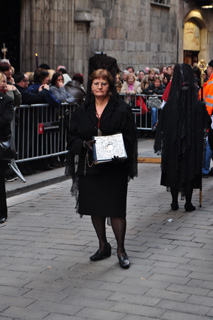
The pointed hood owns a meaning which is a way to be closer to the sky. To know its origin, we will have to go back to the time, until the inquisition time. People, who were punished for religious reasons, had to wear a garment that protects the chest and the back called scapular and a pointed hat as a penance sign. From the 17th century, at Seville, some brotherhoods used this kind of dress for the holy week processions and it is how this tradition has extended without punishments of course.
 |
 |
 |
Nevertheless, the most famous one is the night procession on the good friday because it says to be the most sense and emotional one. The Holy week is very sacred and particularly in south of Spain (above all at Seville) where people live this moment so intensely that, if it rains, they cry because processions of the day must be cancelled.